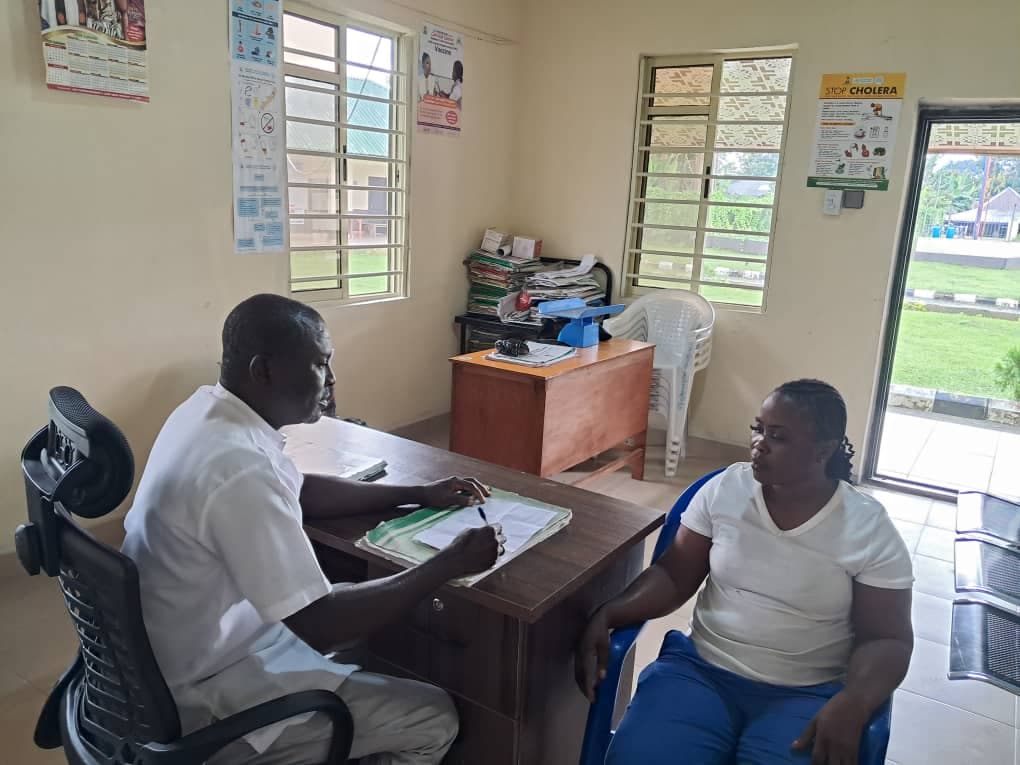
On 24th August 2026, 39-year-old Faith Umorin was stepping out of her room in Udebu, a community in Ahoada East Local Government Area. It was mid-afternoon on a sunny day and she was walking adjacent to some bushes near her home when a snake bit her on the leg.
She immediately felt the pain as she saw the snake, followed by bleeding and swelling at the site.
Faith was frightened.
“I feared that maybe I would die,” she recalled.
Moving quickly, her brother, Bright Umorin, arranged a motorcycle and took her to the neighbouring Primary Health Centre (PHC) in Edeoha.
On arrival, her condition had gotten worse. Bright said she could no longer stand, walk or talk.
At the Health Centre, Community Health Worker Ege Rufus was on duty.
Ege and his healthcare team swung into action. A few months earlier, the Rivers State Primary care Management Board (RSPHCMB) had procured Anti-snake venom for use at 200 healthcare facilities around the State, including Edeoha PHC. The clinical staff at these facilities had been simultaneously trained in snakebite management.
Ege’s training quickly took over. Faith was given 5 doses of anti-venom, followed by supportive and first aid care. During her treatment Ege consulted frequently with his medical officer of heath (MOH), Dr Onyeche, who provided additional real-time clinical support. Faith spent a night in the hospital and was discharged the next day feeling much better, thanks to the timely intervention of the Edeoha PHC staff and the availability of anti-venom.
Faith has since returned to the facility for follow-up. She is now hale and hearty, and firmly believes that she may not be alive today save for the timely intervention a few months earlier by the RSPHCMB to make antivenom available for emergency use at the PHC facilities across the State.
In May 2026, in response to a national conversation about lack of snakebite treatment at some of the nation’s hospitals, the RSPHCMB procured 500 doses of antivenom, intended for distribution to 200 primary health care facilities.
Dr. Onyeche recalls the process of anti-venom introduction into the Primary Health Care facilities in Rivers State: a first in the nation with respect to primary health care.
“We first had the State level training of the MOHs at the Board HQ in Port Harcourt. We came back to the LGAs, did the step-down training of the Facility Heads, Doctors, Nurses and Community Health Workers. At the conclusion of that step-down training, we distributed the anti-snake venom to them.” Dr. Onyeche notes that PHC Edeoha received its anti-snake venom immediately after the LGA step-down training.
Faith now has a simple message for anyone who suffers a snakebite: “I will invite the person to come to the health center”, she emphasized.
She also expressed gratitude to the health workers who treated her. “I thank them for what God has used for them to give me this treatment.” She prayed that God would give the health workers more experience and continue to help them.
Faith's experience offers a human interest illustration of what strengthening primary healthcare can mean at community level: well-trained frontline workers and essential medicines, both available when a patient needs emergency care. In rural communities such as Udebu, timely access to such care can be the difference between life or death.